Facts and data on pictograms

Synonyms / Other Terms Used
Plunging
Category
Sports, Water Sports, Sporting Activities, Activities, Recreation, Tourism
Message / Function
For notice in general, to signify the activity of diving, and to indicate the location of a diving area
| Source | Description | |
|---|---|---|
 |
NZS 8603 | Side view of human figure in starting dive posture next to water shown as two wavy lines |
 |
SVI | Side view of human figure in starting dive posture next to water shown as three blue wavy lines |
 |
GSR Portugal | Side view of human figure in starting dive posture next to water shown as three wavy lines |
 |
France IISR | Side view of human figure in starting dive posture next to water shown as two wavy lines |
 |
Dutchicon | Side view of human figure in starting dive posture, slanted line below |
 |
Aragón | Human figur diving into water from edge, water shown as two wavy lines |
 |
SIS | Side view of human figure diving head first into water shown as two wavy lines, splashes near arms |
 |
NARSSM | Side view of human figure diving head first into water shown as wavy line |
 |
BS 8501:2002 | Side view of human figure diving head first into water shown as two wavy lines |
 |
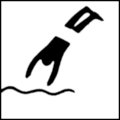
Parks Canada | Side view of human figure diving head first into water shown as wavy line |
 |
Unknown | Human figur diving into water shown as a wavy line |
 |
CNIS | Side view of human figure diving head first from platform into water, shown as two wavy lines |
 |
Erco | Side view of human figure diving into water, water shown as five wavy lines |
 |
O'21 | Side view of human figure performing a somersault, water shown as wavy line |
 |
Sagamihara | Side view of human figure performing a somersault |
 |
Izwar Muis | Side view of human figure performing somersault, water shown as three wavy lines |
 |
O'96 | Side view of human figure diving into water head first, water shown as short wavy line |
 |
O'24 | Side view of diving platform and water, diagonally mirrored image, both separated by diagonal line |
Note: Some of the examples shown above were mirrored horizontally to contrast differences.
Discussion
Almost all pictograms found show a side view of human figure diving head first into water. Differences mostly are based on the phase displayed: in several images the first phase of diving is shown by indicating a starting dive posture, while many other pictograms show the moment just before entering the water. Some images show the edge of a pool, and a few also indicate a diving board. As usual the rendering of the water surface is an element exhibiting the individual style of a uniformly designed system.
Several of the pictogram examples shown in the table above are not intended for the message Diving, but for Swimming Pool, which again usually is indicated by the pictograms for the referent Swimming. If a clear differentiation between Swimming, Swimming Pool, and Diving is possible, and there also is a need for separate pictograms, all three should be designed in such a way that confusions are minimized.
Most research papers found related to this referent have a focus on the hazard related to diving, and symbols or signs examined are generally for the message No Diving. Specific research data on comprehensibility of symbols concerning Diving in our database is limited to one country:
Evaluating the Parks Canada’s National Park and National Historic Sites symbols, also guidance and information symbols were examined using a Comprehension Test according to ISO 9186. For pictogram No 6-4-203: Diving, labeled Parks Canada in the table above, only 56 % of the responses were classified as acceptable. Reporting the results the authors state: 'The remaining responses provided by respondents are related but not explicit to diving allowed such as “swimming area/swimming allowed” (35%). A small proportion of respondents actually mistake this symbol for a sign prohibiting diving “no diving allowed” (5%)' (Ipsos-Reid Corporation, 2003, page 37).
Recommendations
We suggest to compare all concepts available to identify the best image content. The study design should also include a Comprehension Test to identify possible misinterpretations. Detailed information about the most frequent responses given in each of the response categories should be provided to correctly judge comprehensibility and improve designs. On such a basis a clear decision concerning a specific recommendation can be reached.
Tests of pictograms of referent Diving
Ipsos-Reid Corporation (2003): Evaluation of Parks Canada’s National Park and National Historic Sites Symbols – Phase I.
See also
Swimming, Scuba Diving
Beach, Lawn, Sunbathing Area
Updated 2026-06-28 by Christoph Brugger